



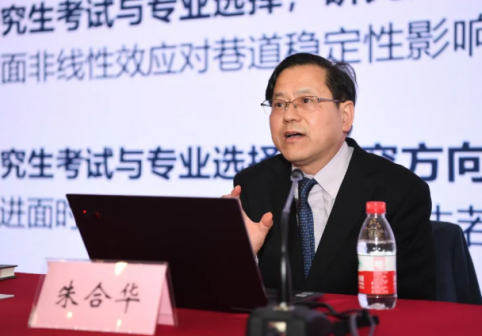
朱合华

朱合华,1962年10月生。1989年10月获得同济大学结构工程专业(地下结构方向)工学博士学位。现为同济大学特聘教授、国家注册土木(岩土)工程师,兼任教育部土木信息技术工程研究中心主任、同济大学隧道及地下建筑工程学科方向负责人。
30多年来一直从事隧道与地下空间领域的教学和科研工作,曾入选国家973项目首席科学家。研究成果“软土盾构隧道设计理论与施工控制技术及应用”获2008年度国家科技进步奖二等奖;“城市高密集区大规模地下空间建造关键技术及其集成示范”获2016年度国家科技进步奖二等奖;另获省部级和一级学会的科技成果特等奖2项、一等奖10项。主参编行业和团体技术标准5部,授权发明专利50余件,出版专著7部,在国内外学术期刊发表高水平论文380余篇,创办国际学术期刊Underground Space(SCIE收录)。获科技部“十一五”科技计划执行突出贡献奖、全国优秀科技工作者、上海市教学名师等荣誉。2012年获卞学鐄国际学术贡献奖,2015年获德国“洪堡研究奖”。
朱合华,男,无党派人士,1962年10月30日出生,安徽巢湖人,隧道与地下空间工程专家,中国工程院院士,国家注册土木(岩土)工程师,同济大学特聘教授,同济大学土木工程防灾减灾全国重点实验室主任 [17]、土木工程学科隧道及地下建筑方向负责人,上海市政府参事。 [1-4] [6] [18]
朱合华1979年至1986年就读于重庆大学,取得学士学位和硕士学位;1989年毕业于同济大学地下建筑与工程系结构工程专业,当年入职同济大学任讲师;1992年任同济大学副教授 ;1993年在日本大阪土质试验所、京都大学作博士后研究;1996年任同济大学教授;1997年兼任地下建筑与工程系副系主任;2000年兼任地下建筑与工程系主任;2004年兼任土木工程学院副院长;2006年兼任土木工程学院院长;2011年在美国Virginia Tech大学做访问教授;2012年任同济大学特聘教授;2016年在德国魏玛包豪斯大学做访问教授;2021年当选中国工程院院士。 [1] [3] [5]
朱合华长期从事数字地下空间工程研究与实践。 [3]
教育经历
1979年至1983年,朱合华本科就读于重庆大学采矿工程系化学矿开采专业。 [1]
1983年至1986年,硕士就读于重庆大学采矿工程系采矿工程专业。 [1]
1986年至1989年,博士就读于同济大学地下建筑与工程系结构工程专业(地下结构方向)。 [1]
工作经历
1989年10至1992年1月,朱合华任同济大学地下建筑与工程系讲师。 [1]
1992年1月至1993年6月,任同济大学地下建筑与工程系副教授(破格)。 [1]
1993年7月至1995年8月,在日本大阪土质试验所、京都大学作博士后研究。 [1]
1995年8月至1997年7月,任同济大学副教授、教授(1996年1月破格)。 [1]
1997年8月至2000年2月,任同济大学教授,兼地下建筑与工程系副系主任。 [1]
2000年3月至2006年3月,任同济大学教授,兼土木工程学院副院长(2004年4月)、地下建筑与工程系主任。 [1]
2006年4月至2010年9月,任同济大学教授,兼土木工程学院院长;2011年8月至2012年7月,在美国Virginia Tech大学做访问教授。 [1]
2010年9月至2012年7月,任同济大学教授。 [1]
2012年7月,任同济大学特聘教授。 [1]
2016年3月至2017年2月,在德国魏玛包豪斯大学做访问教授。 [1]
2021年,当选中国工程院院士。 [3]
2025年,担任上海市住房和城乡建设管理委员会城市地下空间开发与环境保护工程技术创新中心首席专家。 [16]6月,任上海市政府参事。 [18]
主要成就
编辑
科研成就
-
科研综述
朱合华创建了基础设施全寿命数据采集-处理-表达-分析-服务的数字化范式,研发出基础设施智慧服务系统(iS3);合作创建了岩体三维GZZ强度准则,被国际岩石力学学会所推荐;建立了盾构隧道设计分析模型和服役性能的TSI评价方法,被国家和行业标准所采纳。 [3]
-
学术论著&技术标准
据2022年7月中国工程院网站显示,朱合华出版专著8本(含科学漫画1本),发表SCI/EI学术期刊论文380余篇;主参编技术标准5部。 [3]
主要学术论文(部分)
- 1.
Zhu HH, Chen PP, Zhuang XY, et al. Assessment and and structural improvement on the performance of soil chamber system of EPB shield assisted with DEM modeling[J]. Tunnelling and Underground Space Technology, 2020, 96, 103092.
- 2.
Chen Q, Zhu HH, Ju JW, et al. Stochastic micromechanical predictions for the probabilistic behavior of saturated concrete repaired by the electrochemical deposition method[J]. International Journal of Damage Mechanics, 2020, 29(3): 435-453.
- 3.
Wang X, Wu W, Zhu HH, et al. The last entrance plane method for contact indeterminacy between convex polyhedral blocks[J]. Computers and Geotechnics, 2020, 117, 103283.
- 4.
Wu W, Wang X, Zhu HH, et al. Improvements in DDA program for rockslides with local in-circle contact method and modified open-close iteration[J]. Engineering Geology, 2020, 265, 105433.
- 5.
Li XJ, Chen ZY, Chen JQ, Zhu HH. Automatic characterization of rock mass discontinuities using 3D point clouds[J]. Engineering Geology, 2019, 259, 105131.
- 6.
Zhou L, Zhu HH, Yan ZG, et al. Experimental testing on ductile-iron joint panels for high-stiffness segmental joints of deep-buried drainage shield tunnels[J]. Tunnelling and Underground Space Technology, 2019, 87: 145-159.
- 7.
Zhou S, Vu-Bac N, Arash B, Zhu HH, et al. Interface Characterization Between Polyethylene/Silica in Engineered Cementitious Composites by Molecular Dynamics Simulation[J]. Molecules, 2019, 24(8): 1497.
- 8.
Chen XQ, Li XJ, Zhu HH*. Condition evaluation of urban metro shield tunnels in Shanghai through multiple indicators multiple causes model combined with multiple regression method[J]. Tunnelling and Underground Space Technology, 2019, 85: 170-181.
- 9.
Chen XQ, Dong Q, Zhu HH, et al. Contributions of condition measurements on the latent pavement condition by confirmatory factor analysis[J]. Transportmetrica A-Transport Science, 2019, 15(1): 2-17.
- 10.
Zhang Q, Huang BQ, Zhu HH, et al. Quantitative assessments of the correlations between rock mass rating (RMR) and geological strength index (GSI)[J]. Tunnelling and Underground Space Technology, 2019, 83: 73-81.
- 11.
Chen XQ, Zhu HH, Li XJ, et al. Probabilistic performance prediction of shield tunnels in operation through data mining[J]. Sustainable Cities and Society, 2019, 44: 819-829.
- 12.
Zhang Q, Zhu HH. Collaborative 3D geological modeling analysis based on multi-source data standard[J]. Engineering Geology, 2018, 246: 233-244.
- 13.
Chen Q, Zhu HH*, Ju J W, et al. Stochastic micromechanical predictions for the effective properties of concrete considering the interfacial transition zone effects[J]. International Journal of Damage Mechanics, 2018, 27(8): 1252-1271.
- 14.
Chen Q, Zhu HH, Ju JW, et al. A stochastic micromechanical model for fiber-reinforced concrete using maximum entropy principle[J]. Acta Mechanica, 2018, 229(7): 2719-2735.
- 15.
Cai Y, Sun P, Zhu HH, et al. A mixed cover meshless method for elasticity and fracture problems[J]. Theoretical and Applied Fracture Mechanics, 2018, 95: 73-103.
- 16.
Zhu HH, Zhang GC, Cai YC. Locking-free triangular plate element using polynomial incompatible approximation for analysis of cracked thick–thin plates[J]. International Journal of Fracture, 2018, 211(1-2): 1-12.
- 17.
Wu W, Zhu HH*, Lin JS, et al. Tunnel stability assessment by 3D DDA-key block analysis[J]. Tunnelling and Underground Space Technology, 2018, 71: 210-214.
- 18.
Zhu HH, Zhang Q, Huang BQ, et al. A constitutive model based on the modified generalized three-dimensional Hoek–Brown strength criterion[J]. International Journal of Rock Mechanics & Mining Sciences, 2017, 98:78-87.
- 19.
Cai YC, Zhu HH*. A locking‐free nine‐DOF triangular plate element with incompatible approximation[J]. International Journal for Numerical Methods in Engineering, 2017, 109(7).
- 20.
Zhu HH, Wu W, Zhuang XY, et al. Method for Estimating Normal Contact Parameters in Collision Modeling Using Discontinuous Deformation Analysis:[J]. International Journal of Geomechanics, 2016, 17(5):E4016011.
- 21.
Zhuang XY, Wang Q, Zhu HH*. Multiscale modelling of hydro-mechanical couplings in quasi-brittle materials[J]. International Journal of Fracture, 2016:1-27.
- 22.
Zhu HH, Zhou S, Yan ZG, Ju JW, and Chen Q. A two-dimensional micromechanical damage-healing model on microcrack-induced damage for microcapsule-enabled self-healing cementitious composites under compressive loading[J].International Journal of Damage Mechanics, 2016:25(5), 727-749.
- 23.
Zhu HH, Wu W, Chen JQ, Ma GW, Liu XG, and Zhuang XY. Integration of three dimensional discontinuous deformation analysis (DDA) with binocular photogrammetry for stability analysis of tunnels in blocky rockmass[J].Tunnelling and Underground Space Technology, 2016:51, 30-40.
- 24.
Zhu HH, Wang Q, Zhuang XY. A nonlinear semi-concurrent multiscale method for dynamic fractures[J]. International Journal of Impact Engineering, 2015, 87:65-82.
- 25.
Chen JQ, Zhu HH, Li XJ. Automatic extraction of discontinuity orientation from rock mass surface 3D point cloud[J]. Computers & Geosciences, 2016, 95:18-31.
- 26.
Zhu HH, Zhou S, Yan ZG, et al. A 3D analytical model for the probabilistic characteristics of self-healing model for concrete using spherical microcapsule[J]. Computers & Concrete, 2015, 15(1):37-54.
- 27.
Zhu HH, Zhou S, Yan ZG, et al. A two-dimensional micromechanical damage-healing model on microcrack-induced damage for microcapsule-enabled self-healing cementitious composites under tensile loading[J]. International Journal of Damage Mechanics, 2015, 24(1):95-115.
- 28.
Zhu HH, Chen Q, Ju JW, et al. Maximum entropy-based stochastic micromechanical model for a two-phase composite considering the inter-particle interaction effect[J]. Acta Mechanica, 2015, 226(9):3069-3084.
- 29.
Chen Q, Zhu HH*, Ju JW, et al. A stochastic micromechanical model for multiphase composites containing spherical inhomogeneities[J]. Acta Mechanica, 2015, 226(6):1861-1880.
- 30.
Zhuang XY, Wang Q, Zhu HH*. A 3D computational homogenization model for porous material and parameters identification[J]. Computational Materials Science, 2015, 96:536-548.
- 31.
Yan ZG, Shen Y, Zhu HH*, et al. Experimental investigation of reinforced concrete and hybrid fibre reinforced concrete shield tunnel segments subjected to elevated temperature[J]. Fire Safety Journal, 2015, 71(3):86-99.
- 32.
Zhu HH, Zuo YL, Li XJ, et al. Estimation of the fracture diameter distributions using the maximum entropy principle[J]. International Journal of Rock Mechanics & Mining Sciences, 2014, 72(72):127-137.
- 33.
Zhu HH, Chen Q, Yan ZG, et al. Micromechanical models for saturated concrete repaired by the electrochemical deposition method[J]. Materials & Structures, 2014, 47(6):1067-1082.
- 34.
Zhu HH, Ye B, Cai YC, et al. An elasto-viscoplastic model for soft rock around tunnels considering overconsolidation and structure effects[J]. Computers & Geotechnics, 2013, 50(50):6-16.
- 35.
Yan ZG, Zhu HH*, Ju JW. Behavior of reinforced concrete and steel fiber reinforced concrete shield TBM tunnel linings exposed to high temperatures[J]. Construction & Building Materials, 2013, 38(2):610-618.
- 36.
Zhuang XY, Zhu HH*, Augarde C. An improved meshless Shepard and least squares method possessing the delta property and requiring no singular weight function[J]. Computational Mechanics, 2014, 53(2):343-357.
- 37.
Li XJ, Li PN, Zhu HH*. Coal seam surface modeling and updating with multi-source data integration using Bayesian Geostatistics[J]. Engineering Geology, 2013, 164(4):208-221.
- 38.
Zhu HH, Zhuang XY, Cai YC. High rock slope stability analysis using the enriched meshless Shepard and least squares method[J]. International Journal of Computational Methods, 2011, 8(2): 209-228.
- 39.
Xu QW, Zhu HH*, Ding WQ, et al. Laboratory model tests and field investigations of EPB shield machine tunnelling in soft ground in Shanghai[J]. Tunnelling and Underground Space Technology, 2011, 26(1):1-14.
- 40.
Zhu HH, Cai YC, Paik JK, et al. Locking-free thick-thin rod/beam element based on a von Kármán type nonlinear theory in rotated reference frames for large deformation analyses of space-frame structures[J]. Computer Modeling in Engineering & Sciences, 2010, 57(2):175-204.
- 41.
Zhu HH, Liu WJ, Cai YC, et al. A meshless local natural neighbor interpolation method for two-dimension incompressible large deformation analysis[J]. Engineering Analysis with Boundary Elements, 2007, 31(10): 856-862.
- 42.
Zhang LY, Zhu HH. Three-Dimensional Hoek-Brown Strength Criterion for Rocks[J]. Journal of Geotechnical & Geoenvironmental Engineering, 2007, 133(9):1128-1135.
- 43.
周龙, 闫治国, 朱合华等. 深埋排水盾构隧道钢纤维混凝土高刚性接头受力特性试验研究[J]. 建筑结构学报, 2020, 41(4): 177-183+190.
- 44.
朱合华, 丁文其, 乔亚飞等. 简析我国城市地下空间开发利用的问题与挑战[J]. 地学前缘, 2019, 26(3): 22-31.
- 45.
朱合华, 周龙, 朱建文. 管片衬砌梁–弹簧广义模型及接头转动非线性模拟[J]. 岩土工程学报, 2019, 41(9): 1581-1590.
- 46.
朱合华, 李晓军, 林晓东. 基础设施智慧服务系统(iS3)及其应用[J]. 土木工程学报, 2018, 51(1): 6-17.
- 47.
朱合华,武威,李晓军,陈建琴,黄贤斌. 基于 iS3 平台的岩体隧道信息精细化采集、分析与服务[J]. 岩石力学与工程学报, 2017, 36(10):2350-2365.
- 48.
朱合华,周龙,沈奕,闫治国.火灾高温下盾构衬砌结构试验与力学模型综述[J]. 中国公路学报,2017,30(8):15-26.
- 49.
朱合华,李晓军,陈雪琴,陈艾荣,凌建明. 基础设施建养一体数字化技术(2)—工程应用[J]. 土木工程学报,2015,48(6):114-121.
- 50.
朱合华,李晓军,陈雪琴. 基础设施建养一体数字化技术(1)—理论与方法[J]. 土木工程学报,2015,48(4):99-110+123.
- 51.
朱合华,张琦,章连洋. Hoek-Brown强度准则研究进展与应用综述[J]. 岩石力学与工程学报,2013, 32(10): 1945-1963.
- 52.
朱合华, 李晓军.数字地下空间与工程[J]. 岩石力学与工程学报,2007,26(11): 2277-2288.
- 53.
朱合华, 陶履彬. 盾构隧道衬砌结构受力分析的梁-弹簧系统模型[J]. 岩土力学, 1998(2):26-32. [1]
学术著作
- 1.
朱合华等著. 地铁结构演化与感控之科学漫画[M], 上海:同济大学出版社,2016.
- 2.
朱合华等编著. 城市地下空间建设新技术[M], 北京:中国建筑工业出版社,2014.7(获第十五届上海图书奖)
- 3.
朱合华,闫治国著. 城市地下空间防火与安全[M],上海:同济大学出版社,2014.12
- 4.
郑颖人,朱合华,方正昌,刘怀恒编著. 地下工程围岩稳定分析与设计理论[M]. 北京:人民交通出版社,2012.12
- 5.
朱合华等编著. 城市地下空间新技术应用工程示范精选[M], 北京:中国建筑工业出版社,2011.8
- 6.
李志厚,朱合华,丁文其. 公路连拱隧道设计与施工关键技术[M], 北京:人民交通出版社,2010.10
- 7.
杨林德,朱合华,丁文其,黄宏伟等. 岩土工程问题安全性的预报与控制[M]. 北京:科学出版社,2009.3(中国科学院科学出版基金资助)
- 8.
张凤祥,朱合华,傅德明编著. 盾构隧道[M]. 北京:人民交通出版社,2004.10 [9]
-
科研项目
据2022年7月同济大学网站显示,朱合华主持33项省部级以上科研项目,研发同济曙光软件(GeoFBA) [1]。
|
时间
|
项目名称
|
项目来源
|
|
2002年
|
隧道围岩可视化数字地层信息系统与施工监控研究
|
国家自然科学基金项目
|
|
2003年
|
盾构地层适应性设计理论、方法和模拟试验台
|
国家863计划项目
|
|
2005年
|
世博园区数字地下空间基础平台与应用研究
|
国家科技攻关项目
|
|
2006年
|
岩石高边坡裂纹扩展过程的无网格方法模拟研究
|
国家自然科学基金项目
|
|
2007年
|
大深度大断面地下穿越工程与微扰动施工研究
|
国家863计划项目
|
|
2007年
|
城市地下空间防灾减灾技术研究
|
国家科技支撑计划项目
|
|
2007年
|
城市地下空间建设工程化技术开发
|
国家科技支撑计划项目
|
|
2007年
|
软弱破碎隧道围岩渐进性破坏分析与松动荷载预测研究
|
国家自然科学基金项目
|
|
2007年
|
深部岩体工程特性的理论与实验研究
|
国家自然科学基金项目
|
|
2011年
|
城市轨道交通地下结构性能演化与感控基础理论
|
国家973计划项目
|
|
2012年
|
隧道围岩稳定性三维精细化模拟方法与应用
|
国家自然科学基金项目
|
|
2015年
|
火灾高温下饱和软黏土热-水-汽-力多场耦合特性及对隧道结构安全的影响元
|
国家自然科学基金项目
|
|
2019年
|
城市地下基础设施运行综合监控关键技术与示范
|
国家重点研发计划项目
|
|
2019年
|
多波动式岩体-结构复合体内信息高精度采集系统
|
国家自然科学基金项目
|
|
参考资料: [1]
|
||
-
科研获奖&发明专利
据2022年7月中国工程院网站显示,朱合华获国家科技进步二等奖2项,省部级和一级学会的科技成果特等奖2项、一等奖10项;授权发明专利50余件。 [3]
|
时间
|
项目名称
|
奖励种类
|
|
2016年
|
城市高密集区大规模地下空间建造关键技术及其集成示范
|
国家科技进步奖二等奖
|
|
2008年
|
软土盾构隧道设计理论与施工控制技术及应用
|
国家科技进步奖二等奖
|
|
2021年
|
隧道围岩三维连续-非连续破坏机理与精确分析理论
|
中国岩石力学与工程学会自然科学特等奖
|
|
2021年
|
公路隧道病害快速精准感知与处治技术及装备
|
中国公路学会科学技术特等奖
|
|
2017年
|
城市地下基础设施全寿命安全状态快速采集与设备研发
|
上海市技术发明奖一等奖
|
|
2017年
|
岩石混凝土类材料力学行为与动态损伤破坏机理研究
|
中国岩石力学与工程学会自然科学奖一等奖
|
|
2014年
|
城市供水大型输水工程关键技术与示范应用
|
上海市科技进步奖一等奖
|
|
2013年
|
城市高密集区大规模地下空间建造关键技术及其集成示范
|
教育部高校科技成果一等奖
|
|
2011年
|
特大型越江交通基础设施建养一体数字化关键技术
|
上海市科技进步奖一等奖
|
|
2010年
|
盾构穿越成套控制技术及其应用
|
上海市科技进步奖一等奖
|
|
2009年
|
双洞八车道公路隧道建设关键技术研究
|
广东省科技进步奖一等奖
|
|
2006年
|
软土盾构隧道设计理论与施工控制技术及应用
|
教育部高校科技成果一等奖
|
|
2006年
|
大断面管幕-箱涵顶进应用技术研究
|
上海市科技进步奖一等奖
|
|
2003年
|
上海崇明越江通道工程风险分析研究
|
上海市决策咨询研究成果奖一等奖
|
|
参考资料: [7] [10-11] [13-14]
|
||
人才培养
-
学生培养
据2022年7月同济大学官网显示,朱合华领衔的土木信息技术教育部工程研究中心导师团队,已培养博士10位,硕士27位。 [8]
-
教育理念
求学:学习是一辈子的事情,无论世界如何变化,学习总能让自己与时俱进。专业的选择重要也不重要,关键在于自己是否能够努力学好,掌握自己的学习之路。 [11]
治学:治学之道始于方向。“三结合”是选择研究方向的基石,即基础与应用研究的结合、传统与现代的结合、近期与远期研究的结合。要注重学科交叉,但一定要以本学科为主;既要关注眼前的问题,也要找准未来的着眼点。 [11]
荣誉表彰
|
时间
|
荣誉表彰
|
授予单位
|
|
2011年
|
上海市教学名师
|
上海市教育委员
|
|
2012年
|
卞学鐄(THHP)奖
|
国际计算力学顶级会议(ICCES) [3]
|
|
2012年
|
全国优秀科技工作者
|
科学技术部
|
|
2015年
|
德国洪堡研究奖
|
德国亚历山大·冯·洪堡基金会 [3]
|
|
2021年
|
中国工程院院士
|
中国工程院 [3]
|
社会任职
编辑
|
时间
|
担任职务
|
|
2010年
|
日本大阪地域地层环境研究所顾问
|
|
2011年至2020年
|
英国剑桥大学智慧基础设施与施工中心(CSIC)顾问
|
|
2017年
|
国际岩土联合会(FedIGS)岩土数据标准专业委员会(JTC2)主席
|
|
——
|
中国岩石力学与工程学会、中国土木工程学会隧道及地下工程分会副理事长
|
|
——
|
《中国大百科全书》(第三版)土木工程学科《土木信息工程》分卷的主编
|
|
2025年
|
上海市住房和城乡建设管理委员会城市地下空间开发与环境保护工程技术创新中心首席专家 [16]
|
|
参考资料: [1]
|
|
人物评价
编辑
朱合华是城市基础设施规划、设计、施工和维护信息集成方法的国际开拓者之一。(国际同行评) [3]
朱合华是地下空间研究“数字化”的引领者。(上海科技报评) [12]
朱合华是中国在数字地下空间与工程(DUSE)研究领域的领军人物之一和数字地下空间与工程研究方向的国际著名学者。(合肥工业大学评) [15]